Selected papers by Luigi Logrippo and associates (other papers
can be found here)
The following list is a mix
of recent papers and older ones that may still be useful, in chronological
order.
In most cases, they are corrected or updated versions
of published papers.
Refer to the publisher’s sources to find the published
versions.
If you have remarks or questions on these materials, I
am interested in hearing from you.
PDF Luigi Logrippo. The theory of access control and flow control for data security: From Partial
orders to Lattices and back, a half-century trip. Position paper, May 2025.
PDF Luigi Logrippo. Data flow security in
Role-Based Access Control (RBAC). Journal of Information Security and
Applications. 2025 May 1;90:103997.
PDF Luigi Logrippo. The order-theoretical foundation for data flow security. Technical
report, Université du Québec en Outaouais, 2023. (This
paper was submitted to a journal, which proposed it to six potential referees,
all of which declined).
PDF Alireza Parvizimosaed, Sepehr
Sharifi, Daniel Amyot, Luigi Logrippo, Marco Roveri, Aidin Rasti, Ali Roudak,
John Mylopoulos. Specification and Analysis of Legal Contracts with Symboleo. Softw. Syst. Model. 21(6): 2395-2427 (2022).
PDF Abdelouadoud Stambouli, Luigi
Logrippo. Implementation of a partial order data security model for the
Internet of things (IoT) using Software defined networking (SDN). Journal of
Cybersecurity and Privacy 4 (3) (2024), 468-493.
PDF John Mylopoulos, Daniel Amyot, Luigi Logrippo, Alireza Parvizimosaed, Sepehr Sharifi. Social Requirements Models for Services. Next-Gen Digital Services
2021 Essays Dedicated to Michael Papazoglou on the Occasion
of His 65th Birthday and His Retirement. LNCS 12521, Springer 2021, ISBN
978-3-030-73202-8: 100-108
PDF Luigi Logrippo, Abdelouadoud
Stambouli. Proposal for industrial tools for data security (2020). Our recent
papers have led to the discovery of methods and algorithms of industrial interest, they are described here. Technical Report : Université du Québec en
Outaouais, December 2020.
PDF Alireza Parvizimosaed, Sepehr
Sharifi, Daniel Amyot, Luigi Logrippo, John Mylopoulos. Subcontracting,
Assignment, and Substitution for Legal Contracts in Symboleo. Intern. Conf. on
Conceptual Modeling, ER 2020, Springer LNCS 12400, 271-285. ISBN 978-3-030-62521-4.
PDF Sepehr Sharifi, Alireza Parvizimosaed, Daniel Amyot, Luigi Logrippo,
John Mylopoulos. Symboleo: Towards a Specification Language for Legal
Contracts. 28th IEEE Intern. Requirements Engineering Conference (RE
2020),364-369. ISBN 978-1-7281-7438-9.
PDF Luigi Logrippo. Multi-level models for data security in networks and in the Internet of
things. Journ. of Information Security and Applications (Elsevier) 58: 102778
(2021).
PDF Luigi Logrippo, Abdelouadoud
Stambouli. Configuring data flows in the Internet of Things for security and
privacy requirements. 11th International Symposium on Foundations and Practice
of Security (FPS 2018). Montreal, Nov. 13-15, 2018. Springer LNCS 11358,
115-130. See also the presentation.
PDF Abdelouadoud Stambouli, Luigi
Logrippo. Data flow analysis from capability lists, with application to RBAC
and LaBAC. Augmented version of paper titled: Data flow analysis from
capability lists, with application to RBAC. Information Processing Letters (Elsevier)
141 (2019) 30–40.
PDF Luigi Logrippo. Multi-level
access control, directed graphs and partial orders in flow control for
data secrecy and privacy. Augmented version of paper appeared in: Foundations
and Practice of Security. FPS 2017. Springer LNCS 10723 (2018), 111-123.
Springer, DOI https://doi.org/10.1007/978-3-319-75650-9_8. See also the presentation.
PDF Sofiene Boulares, Kamel Adi, Luigi
Logrippo. Insider threat likelihood assessment for flexible access control. Proc. of the 7th Intern. MCETECH
Conference on eTechnologies. Ottawa, 2017. Refer to
Springer site for the official copy. In: Aïmeur E., Ruhi U., Weiss M. (eds)
E-Technologies: Embracing the Internet of Things. LNBIP 289, Springer, 77-95.
PDF Sofiene Boulares, Kamel Adi, Luigi
Logrippo. Insider threat likelihood assessment for access control systems:
Quantitative approach. Proc. of the 9th International Symposium on
Foundations and Practice of Security (FPS), Québec, October 2016, Lecture Notes
in Computer Science 10128, Springer 2017, 135-142. Springer Copyright. Refer to
Springer LNBIP site for the official copy.
PDF Luigi
Logrippo, Causality in Computer Science.
Letter to the
Editor of the Communications of the ACM, 59(7), 9, 2016.
PDF Riaz Ahmed Shaikh, Kamel Adi, Luigi Logrippo. A data classification
method for inconsistency and incompleteness detection in access control policy
data sets. International
Journal of Information Security, 16(1), 91-113, 2017. A related policy generation tool
is available.
PDF Jamal Abd-Ali, Karim El Guemhioui,
Luigi Logrippo. Metamodelling with Formal Semantics
with Application to Access Control Specification. MODELSWARD 2015: 354-36
PDF Jamal Abd-Ali, Karim El Guemhioui,
Luigi Logrippo. A Meta-model for Access Control Policies. Journal of Software
10(7), 2015, 784-797.
PDF
Sofiene Boulares, Kamel Adi, Luigi Logrippo. Information flow-based security
levels assessment for access control systems. LNBIP 209 105-121. Proc. of the
6th International MCETECH Conference on eTechnologies.
Montreal, May 2015. Springer Copyright. Refer to Springer LNBIP site for the
official copy.
PDF Luigi Logrippo. Logical Method for Reasoning about Access Control and
Data Flow Control Models. Proc. of the 7th International Symposium
on Foundations and Practice of Security, Montréal, Nov. 2014. F. Cuppens et al.
(Eds.): FPS 2014, LNCS 8930, 205–220, 2015. Springer Copyright. Refer to
Springer LNCS volume for the official copy (this is an extended version). (See
also PRESENTATION). This
paper is my first in this research direction, My view
of this topic has changed considerably.
PDF Omar Abahmane, Luigi Logrippo. Granularity Based Flow Control. Proc. 12th Annual
International Conference on Privacy, Security and Trust (PST), Toronto, July
2014, 239-248. (see also PRESENTATION).
PDF Salim Khamadja, Kamel Adi, Luigi Logrippo. Designing Flexible Access Control Models for the
Cloud. Proc. of the 6th International Conference on Security of Information and
Networks (SIN 2013), Aksaray, Turkey, Nov. 2013,
225-232. ACM Copyright. Refer to ACM site for official copy.
PDF Waël Hassan, Luigi Logrippo. Towards a
Process for Legally Compliant Software. Proc. 6th International IEEE Workshop
on Requirements Engineering and Law, (RELAW 2013) Rio de Janeiro, 44-52. IEEE
copyright: Refer to IEEE site for official copy.
PDF Hemanth Khambhammettu,
Sofiene Boulares, Kamel Adi, Luigi Logrippo. A Framework for Risk Assessment in
Access Control Systems.
Computers & Security (Elsevier),
39, Part A, 2013, 86-103.
PDF Muyiwa Olurin, Carlisle
Adams, Luigi Logrippo. Platform for Privacy Preferences (P3P): Current Status
and Future Directions. In: N. Cuppens-Boulahia, P.Fong, J. García-Alfaro, S. Marsh, J.-P. Steghöfer (Eds.): Tenth Annual International Conference on
Privacy, Security and Trust, PST 2012, Paris, France, July 16-18, 2012,
217-220.
PDF Riaz Ahmed Shaikh, Kamel Adi, Luigi Logrippo. Dynamic
Risk-based Decision Methods for Access Control Systems. Computers and Security
(Elsevier), 31(4): 447-464, 2012.
PDF Bernard Stepien, Hemanth Khambhammettu, Kamel Adi, Luigi Logrippo. CatBAC: A Generic Framework for Designing and Validating
Hybrid Access Control Models. Proc. of SFCS 2012, the First IEEE International
Workshop on Security and Forensics in Communication Systems, Ottawa, June
10-15, 6721-6726.
This paper continues the work
presented in the paper by Slimani et al. (see below) by presenting an access
control language that extends the graphical UML notation proposed in this
second paper.
PDF Yacine Bouzida,
Luigi Logrippo, Sergei Mankovski. Concrete and Abstract Based Access Control. Intern.J.
of Inform. Security, 10 (4) Aug. 2011, 223-238. Copyright by
Springer www.springerlink.com.
PDF Logrippo, L. From e-business to e-laws and
e-judgments: 4,000 years of experience. CYBERLAWS 2011, Proc. of the Second
International Conference on Technical and Legal Aspects of the e-Society,
Guadeloupe, Feb 2011, 22-28.
Several Google
searches in year 2011 on keyword ‘e-judgment’ or ‘electronic judgment’ have
consistently ranked this document among the top five. The other documents
listed used the term in a different meaning (as databases of judgments). So it appears that I am the inventor of this term. We’ll see
how useful it will be. In 1961, fresh from law school, I was hired to study the
uses that computers could have in legal establishments. It then occurred to me
that computers could help decide simple legal cases. It took me fifty years to
come up with a paper on this topic! People interested in this subject may be
interested also in the following: HTML
PDF Slimani, N., Khambhammettu, H., Adi, K., Logrippo, L.
UACML: Unified Access Control Modeling Language. In: New Technologies, Mobility
and Security (NTMS), 2011 4th IFIP Intern. Conf. on, 2011, 1-8. http://ieeexplore.ieee.org/stamp/stamp.jsp?tp=&arnumber=5721143
PDF Ma, J., Logrippo, L., Adi, K., Mankovski, S. Risk
Analysis in Access Control Systems Based on Trust Theories. The 3rd Workshop on
Logics for Intelligent Agents and Multi-Agent Systems (WLIAMas
2010). Toronto, Aug. 2010, 415-418.
http://ieeexplore.ieee.org/stamp/stamp.jsp?tp=&arnumber=5614467
Shaikh, R.A., Adi, K., Logrippo, L., Mankovski, S. Inconsistency
Detection Method for Access Control Policies. IEEE sixth
International Conference on Information Assurance and Security (IAS 2010),
Atlanta, Aug. 2010, 204-209. This paper has been superseded by our 2017
paper: PDF
PDF Ma, J., Adi, K., Mejri, M., Logrippo, L. Risk Analysis
in Access Control Systems. Eight Intern. Conf. on Privacy, Security, and Trust
(PST 2010). Ottawa, Aug. 2010, 160-166.
http://ieeexplore.ieee.org/stamp/stamp.jsp?tp=&arnumber=5593248
Shaikh, R.A., Adi,K., Logrippo, L., Mankovski,
S. Detecting Incompleteness in Access Control Policies Using Data
Classification Schemes, In Proc. of the 5th International Conference on Digital
Information Management (ICDIM 2010), Thunder Bay, Canada, July 2010, IEEE Press, 417-422. This paper has been superseded by our 2017
paper: PDF
PDF Ma, J., Adi, K., Logrippo, L., Mankovski, S. Risk
Management in Dynamic Role Based Access Control Systems. Proc.
of the 5th International Conference on Digital Information Management (ICDIM
2010), Thunder Bay, Canada, July 2010, IEEE Press, 423-430.
http://ieeexplore.ieee.org/stamp/stamp.jsp?tp=&arnumber=5664658
PDF Plesa, R., Logrippo, L. An Agent-Based Architecture
for Providing Enhanced Communication Services. Chapter 15 in: Laurence T. Yang
(Ed.) Research in Mobile Intelligence – Wiley series on Parallel and
Distributed Computing, 2010. 320-342.
PDF Hassan, W., Slimani, N., Adi, K., Logrippo, L.,
Secrecy UML method for model transformations. 2nd International Conference ABZ
Short Papers, 2010, 16-21.
PDF Hassan, W., Logrippo, L. A Governance Requirements
Extraction Model for Legal Compliance Validation. In Proc. IEEE 17th
International Requirements Engineering Conference (RE'09): RELAW Workshop.
Atlanta, GA. Sep. 2009, 7-12.
http://ieeexplore.ieee.org/stamp/stamp.jsp?tp=&arnumber=5459844
PDF Adi, K., Bouzida, Y., Hattak, I., Logrippo, L., Mankovskii, S. Typing for Conflict Detection in Access
Control Policies. In: G. Babin, P. Kropf, M. Weiss (Eds.): E-Technologies:
Innovation in an Open World. Proc. of the 4th Intern. Conf. MCETECH
2009 (Ottawa, May 2009), Lecture Notes in Business Information Processing
(LNBIP 26), Springer, 2009, 212-226.
PDF Hassan, W., Logrippo, L. Detecting
inconsistencies of mixed secrecy models and business policies. University of
Ottawa Technical Report, 2009.
PDF
Hassan, W. and Logrippo, L. Requirements and Compliance in Legal
Systems: a Logic Approach. In Proc. IEEE 16th International Requirements
Engineering Conference (RE'08): RELAW Workshop. Barcelona, Spain. Sep. 2008, 40-44.
http://ieeexplore.ieee.org/stamp/stamp.jsp?tp=&arnumber=4797473
PDF Logrippo, L. Normative Systems: the
Meeting Point between Jurisprudence and Information Technology? In: H. Fujita,
D. Pisanelli (Eds.): New Trends in Software Methodologies, Tools and Techniques
– Proc. of the 6th SoMeT_07. IOS Press, 2007, 343-354.
PDF Layouni, A., Logrippo, L., Turner, K.J. Conflict Detection in
Call Control Using First-Order Logic Model Checking. In: L. DuBousquet,
Jean-Luc Richier (Eds): 9th International Conference on Feature Interactions in
Software and Communication Systems, IOS Press, 2008 (Proc. of ICFI ’07,
Grenoble, France, Sept. 2007), 77-92.
PDF
Plesa, R., Logrippo, L. An
Agent-Based Architecture for Contex-Aware
Communications. Proc. of the 21st International Conference on Advanced
Information Networking and Applications Workshops (PCAC-07 Niagara Falls, May
2007), IEEE Press, Vol.2, 133-138.
http://ieeexplore.ieee.org/stamp/stamp.jsp?tp=&arnumber=4224094
PDF Xu, Y., Logrippo, L., Sincennes, J. Detecting Feature
Interactions in CPL. Journal of Network and Computer Applications 30 (2)
(2007), 775-799.
Keywords: Call Processing Language, consistency
PDF Crespo, R.G., Carvalho, M., Logrippo, L. Distributed
Resolution of Feature Interactions for Internet Applications. Computer Networks
51 (2) (2007) 382-397.
PDF Jiang, D., Liscano, R., Logrippo, L. Personalization
of Internet Telephony Services for Presence with SIP and Extended CPL. Computer
Communications 29 (18)
(Nov. 2006)
3766-3779.
PDF Gorse, N., Logrippo, L., Sincennes, J. Formal
Detection of Feature Interactions with Logic Programming and LOTOS. Journal on Software and System Modelling, 5
(2), 2006,
121-134.
Note 1: This paper was mistakenly published
under the title: Detecting Feature Interactions in CPL. Note 2: Although the title of this paper is rather specific with
its reference to Logic Programming and LOTOS, the principles presented in the
first part are generic and have been used in other papers.
PDF de Castro Andrade, R. M., Logrippo, L. MoRaR: A
Pattern Language for Mobility and Radio Resource Management. Appeared in
reedited form in: D.Manolescu,
J.Noble, M. Voelter - Pattern Languages of Program Design 5, Chapter
10. Addison-Wesley, 2006, 213-255
This paper is a rather extensive
study of patterns occurring in mobile telephony systems software, almost unique
in its kind.
PDF Amyot, D., Gray, T., Liscano, R., Logrippo, L.,
Sincennes, J. Interactive Conflict Detection and Resolution for Personalized
Features. Journal of Communications and Networks, 7 (3), 2005, 353-366.
PDF Plesa, R., Logrippo, L. Enhanced Communications
Servers through Context Integration. In T. Magedanz, A. Karmouch, S. Pierre, I.
Venieris (Eds) - Mobility Aware Technologies and
Applications – (MATA, Montreal Oct. 2005) Short papers volume, 1-5.
PDF Mankai, M., Logrippo, L. Access
Control Policies: Modeling and Validation. Proceedings of NOTERE 2005
(Gatineau, August) 85-91. Keywords: XACML, consistency checking, Alloy
This was one of the very first papers
published on the subject of consistency checking for
XACML policies but it doesn’t get cited. Oh, well …
PDF Hassan, W., Logrippo, L. Governance Policies for
Privacy Access Control and their Interactions. In: S.Reiff-Marganiec, M.D. Ryan (Eds) Feature
Interactions in Telecommunications and Software Systems. (Proc. of the VIII
International Conference on Feature Interaction, ICFI 2005), Leicester, UK, IOS
Press, 2005, 114-130.
PDF Amyot, L., Logrippo, L., Weiss, M. Generation of test
purposes from Use Case Maps. Computer Networks 49 (5), 2005, 643-660.
PDF Dini, P., Clemm, A., Gray, T., Lin, F.J., Logrippo,
L., Reiff-Marganiec, S. Policy-enabled Mechanisms for
Feature Interactions: Reality, Expectations, Challenges. Computer Networks, 45
(5), 2004, 585 - 603.
Old papers that
are still cited occasionally …
This is a repository where I put papers that are still
being cited or for which I have received requests.
PDF Haj-Hussein, M., Logrippo, L.,
Sincennes, J. Goal-oriented Execution of LOTOS Specifications. In: M. Diaz and R. Groz
(Eds.) Formal Description Techniques, V. North- Holland, 1993 (Proc. of the 4rth FORmal
TEchniques International Conference, Perros- Guirec,
France, 1992. Sponsored by IFIP WG 6.1) 311-327.
The concept of goal-oriented
execution for LOTOS was discovered almost simultaneously by our group and a
Dutch group (Ed Brinksma and Henk Eertink). It is
applicable to CCS and CSP, as well as to other process-algebraic languages.
However strangely, many years later, this extension has not been done, for what I know. It is a useful technique for state
exploration in infinite-state systems. The PhD thesis of Mazen Haj-Hussein,
that explained the concept in detail, is available in
the web.
PDF Logrippo, L., Faci, M., and Haj-Hussein, M. An
Introduction to LOTOS: Learning by Examples.
Computer Networks and ISDN Systems 23(5) (1992) 325-342. Errata in 25(1)
(1992) 99-100.
PDF Guillemot, R.,
Haj-Hussein, M., Logrippo, L. Executing large LOTOS specifications. In: S.
Aggarwal, K. Sabnani (Eds): Protocol Specification, Testing and Verification
VIII (Proc. of the PSTV VIII Symposium). Elsevier-IFIP 1988, 399-410.
PDF Logrippo, L.,
Obaid, A., Briand, J.P., Fehri, M.C. An Interpreter for LOTOS, a Specification
Language for Distributed Systems. Software-Practice and Experience Vol 18(4),
365-385 (April 1988).
Note: This paper was written in
1986. It presents the first LOTOS interpreter realized in the world. However the language discussed is different from the one
that eventually became a standard.
PDF Vissers, C.A.,
Logrippo, L. The Importance
of the Service Concept in the Design of Data Communications Protocols.
This paper appeared, in slightly
different form, in M. Diaz (Ed.) Protocol Specification, Testing, and
Verification, V. (Proc. of the IFIP WG 6.1 Fifth International Workshop on
Protocol Specification, Testing and Verification) Elsevier-North-Holland, 1986,
3-17.
PDF Logrippo, L., Stepien, B. Cluster Analysis for the
Computer-Assisted Statistical Analysis of Melodies. Computers and the
Humanities, Vol. 20, No. 1, 19-33 (Jan.-March 1986).
Keywords: Inuit music; Canadian
Eskimo music; a-ja-jai songs; ajajai songs;
statistical methods in ethno-musicology; transcriptions; music score.
A chapter by the same authors,
including further documentation on this work, can be found in the following
book: Pelinski, R. La musique des inuit
du caribou. Presses de l’Université de Montréal,
1981. Because this book is out of print, I have put on line the following
excerpts (PDF) which include: 1) transcriptions of
the songs collected by Pelinski; 2) information on the CD realized by Pelinsky,
which I believe can still be purchased.
PDF Pelinski, R., Logrippo, L., Hickey, P.J., Strong, E. A
comparative computer analysis of Inuit songs. University of Ottawa, Computer
Science Department, Technical Report TR80.08 (1980).
Keywords: Inuit music; Canadian
Eskimo music; a-ja-jai songs; ajajai songs;
statistical methods in ethno-musicology. See also previous title.
Open
Distributed Processing (ODP) Tutorials
The Open Distributed Processing (ODP) concept was much
ahead of its time and is still of current interest.
Although this is not often recognized, the Service
Oriented Architecture (SOA) is based on ODP concepts.
Here are some tutorial papers and research reports
that we wrote quite a while ago (1993-1996), with my student Kazi Farooqui.
I think that they are still useful.
PDF Farooqui, K., Logrippo, L., DeMeer,
J. The ISO Reference Model for Open Distributed Processing:
an introduction.
Computer Networks and ISDN Systems 27 (1995) 1215-1229.
PDF Farooqui, K., Logrippo, L. Architecture for Open
Distributed Software Systems. Technical Report, University of Ottawa, 1994. A shorter version of this tutorial was
published in: Zomaya, A.Y.S. (Ed.). Parallel and Distributed Computing
Handbook. McGraw-Hill, 1996, 303-329.
PDF Farooqui, K., Logrippo, L. Introduction to the ODP
Computational Model. Technical Report, University of Ottawa, 1994.
PDF Farooqui, K., Logrippo, L. Introduction to the ODP
Engineering Model. Technical Report, University of Ottawa, 1994.
Very old papers
that haven’t been cited at all…
Some of my best papers are those that resulted from my
PhD thesis, years of work… with the help of my supervisors, John Brzozowski and
Ed Ashcroft, as well as the inspiration of my external examiner, Ray Miller.
They have received extremely few citations, probably because the topic has not
been fashionable. But I know that they are a lot better than some papers of
mine that have been cited dozens of times. So much for citation counts.
PDF Logrippo, L. Renamings and Economy of Memory in Program Schemata. J. ACM
25(1), (Jan. 1978), 10-22
It is possible to change the name of
the variables in programs in such a way that the results computed are unchanged.
This equivalence-preserving transformation is at the basis of program
optimizations such as efficient register allocation or efficient memory
allocation, used in optimizing compilers. This paper justifies theoretically
this transformation and explains how it works.
PDF Logrippo, L. Renamings,
Maximal Parallelism, and Space-Time Tradeoff in Program Schemata. J. ACM 26(4),
(Oct. 1979), 819 - 833
This paper continues the work
presented in the previous paper. It shows formally that by allocating more
memory space, more variables, or more registers, the parallelism of a program
can be increased. For example, the parallelism of a producer-consumer system
can be increased by increasing the length of the queue between the producer and
consumer. Pipelined processors with instruction look-ahead use the same
principle. This equivalence-preserving transformation can be applied
automatically in order to take advantage of
computational resources as they become available, at execution time or at
compilation time.
It is useful to
review the results of this paper in the light of Amdahl’s famous law. One of
several ways of interpreting this law states that the speedup that can be
obtained in the execution of a program P by using increasingly larger numbers
of processors in parallel computing arrangements is limited by the time needed
for executing the sequential parts of P. Amdahl’s law assumes that the
sequential and parallelizable parts of P are known in advance and cannot be
changed (unless the program is redesigned). This paper shows that: 1) it may be
possible to execute a program at different levels of parallelisms at different
points of execution 2) it may possible
to increase the parallelism of a program by spreading its working space in
memory, essentially by using queue or queue-like mechanisms. This paper also
characterizes the program structures where this can or cannot be done.
Intuitively, these concepts are well recognized in Computer Science
however here they are formally analyzed.
Some
non-technical papers
HTML From Sumerian Codes to Computer Code: A Formal Logic
Perspective on Legal Theory and Information Technology in a Historical Context.
This is a sort of evolving notebook
that I keep on this subject. I make it available in case others are interested
and I am always interested in readers’ opinions.
HTML Pierre Stanislas Bédard : a precursor of symbolic logic. October 2013
PDF Mario Bolognani, Luigi Logrippo. Le origini del software industriale in Italia (The origins of
Software Industry in Italy, in Italian). Sviluppo e Organizzazione,
Marzo-Aprile 2009, 52-63.
HTML My first two
computers: Elea 9003 and Elea 6001. Winter 2007.
PDF Review of two books on early electronic music in
Italy. MusicWorks. Winter 2006
PDF A capsule history of the Department of Computer Science, University of
Ottawa
HTML Memorial: Otto G. Wadsted
Neither papers,
nor technical, nor mine!
PDF L’église de Saint Joachim. Sculptures
par François Baillargé et autres, photos par Licia Paolucci
PDF
(1 MB); JPEG (6 MB);
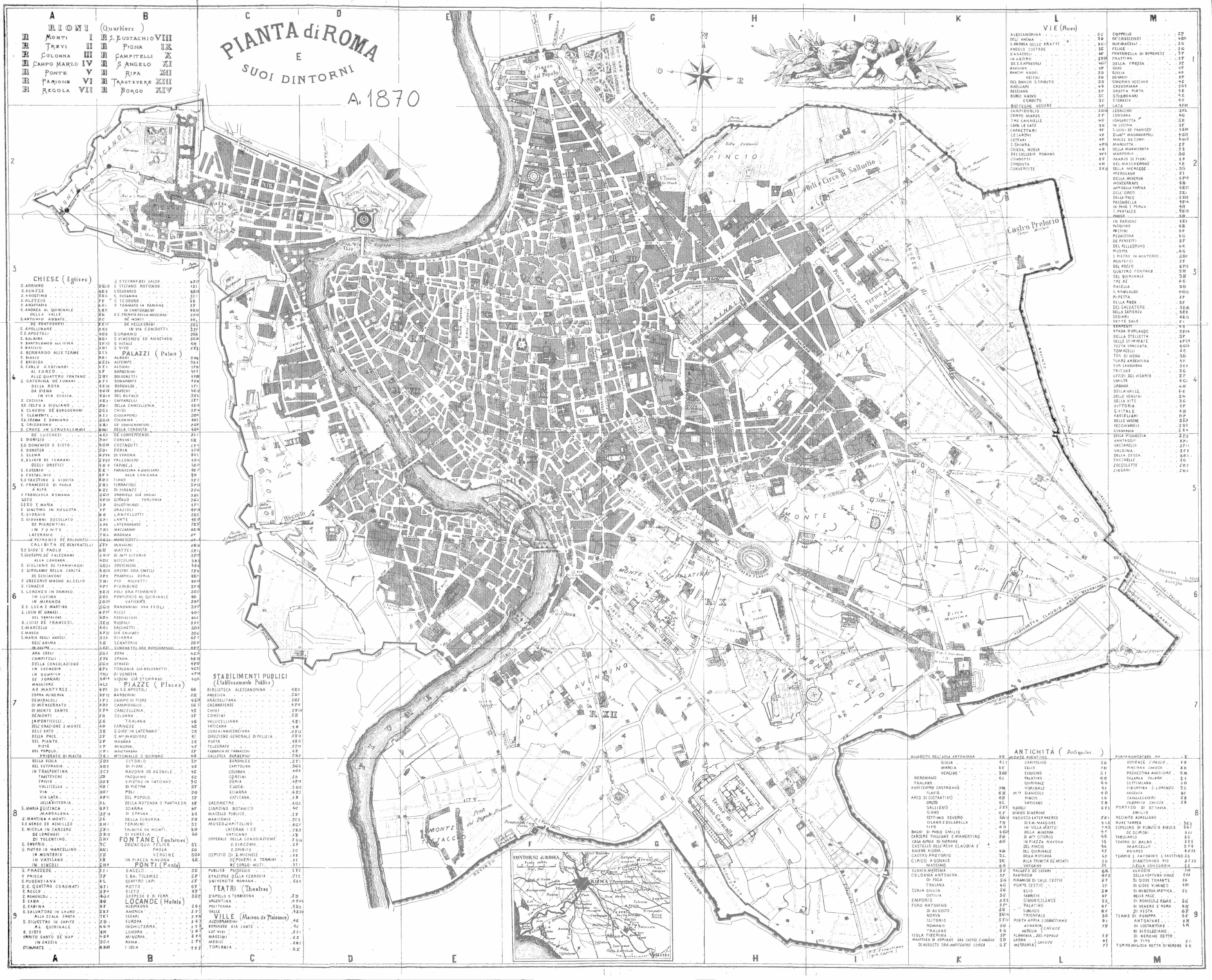
TIFF (97 MB); IMAGO URBIS ROMAE ANNO
MDCCCLXX – Pianta Map Carte Roma Rome 1870
PDF Ayler’s Christmas: Zipped file of Bernard Stepien’s
Mashups: Ayler tunes with Christmas carols