Memories of a ‘bare-metal’ programmer
By Luigi Logrippo
Started January 2007 – Last updated October 2022.
The Olivetti Elea 9003 was the first industrial
electronic computer made in Italy. The first 9003 was completed in 1958 and its
commercial announcement was made in 1959. The first operational specimens were
installed in 1960, and the last in 1964. About 40 were produced. Its
predecessors, the Elea 9001 and 9002, were not for sale and used vacuum tubes.
For those who want to know a lot about the Elea 9003,
and can read Italian or are willing to go through Google Translate, here is the
Programmer’s Manual (pdf,
128M). For those who just want to browse, the manual includes some interesting
pictures.
The Elea 9003 CPU
was entirely transistorized, but not integrated. In fact, there were
approximately 300,000 components in a typical system, between transistors and
diodes. In the RAM module, each bit was stored in a ferrite ring (a core, hence the first meaning of the term
core memory). The diameter of each core was approximately mm. 1 and each
core was crossed by 4 copper wires. A character consisted of six bits with an
additional parity bit (the latter not visible from program), so a memory module
of 10,000 characters required 70,000 cores –and each was threaded
manually! The size of such a module,
with the addressing circuitry, was of approximately cm. 50x45x20. The ‘periodo
di cifra’=memory cycle (access to one character for reading or writing) was 10
microseconds, thus the machine’s speed was 100KHz. This was fairly standard
technology around 1960, in fact initially somewhat ahead of other competing
systems.
Just as other
computers of the time, this one was a… dinosaur. It occupied large, air-conditioned
rooms. It consisted of a series cabinets interconnected by overhead wiring,
each about 1.5 meters high. A cabinet included main memory and CPU (additional
cabinets were required for memory extensions). A second cabinet was the control
unit for the tape units. A third cabinet would contain the control unit for
other peripherals such as the printer. The tape units and the peripherals
themselves were quite bulky. Happily, the machine looked good because it was
designed by a famous architect, Ettore Sottsass. Several pictures are available
in the Web.
It has been claimed that this was the first fully
transistorized commercially distributed computer in the world. This claim is
difficult to substantiate for a time when all computers still contained some
vacuum tubes (I believe that the 9003 had some in the power system). IBM had
announced a fully transistorized system 608 in mid-1955, however it is unclear
whether this one should be relegated to the category of punched-card equipment:
it was programmed from a patch-board and it was extremely limited in terms of
memory and number of program steps. The Metropolitan-Vickers MV950 of 1956 has
been cited as the first transistorized computer to become commercially available.
Siemens had announced a fully transistorized System 2002 some months before the
9003. IBM transistorized mainframes followed months later; in fairness, it must
be said that these were shipped with a good set of software tools from the
start, which was not the case for the Elea. However surely the Elea 9003 was
among the very first in the world in this category. And Olivetti management
showed a lot of vision and courage to bet on transistor technology at a time
when leading computer manufacturers were still selling vacuum tube technology.
A variant of
Binary-Coded Decimal (BCD) representation was used for addresses and data. The
basic storage unit was the ‘character’. With six bits per character, there were
sixty-four possible characters. However the binary encoding of numeric
characters was not the usual one: e.g. 2 was 000011, 3 was 000111 (see programmer’s reference card).
The decision of
using decimal, rather than binary, representation of numeric quantities and
addresses was friendly to programmers but created some problems. For one,
numeric quantities required more bits than necessary for binary
representations, since numeric characters had two bits (of six) that were always
0. This is normal in today’s large memories but had consequences in the memory
sizes of the times. In addition, if the addresses could only be numeric, the
maximum memory size would have been 9999. In order to allow addressing the
second memory bank the address after 9999 was ø000, and after ø999 we had A000. Somehow, address 40,000 was 0ø00, no need to get into further details … Since the T registers were used for
addresses, the arithmetic on the T registers had to give valid addresses and
thus was different from the arithmetic for the accumulator. The complexity of
the arithmetic unit was considerable for the time. Correspondingly, the logic
of several instructions, especially those involving registers, was complicated.
Even leading programmers, asked many years later, could not answer some
specific questions.
Of course there
was no dynamic memory allocation so each program would be loaded contiguously
always at the same memory location, and would be the only program in memory
during its execution. All memory was usable by the programmer, although it
became usual to leave the first 3,000 characters available for testing
programs.
There were no
floating point representation nor floating point instructions, this computer
being designed for commercial applications.
Memory size could go from 10K (one memory module) to
160K characters, with typical sizes around 40K. The CPU had an accumulator
register of the capacity of 100 characters, and this was the main operating
register of the programming logic. There were also 40 additional registers,
called T registers, each of the capacity of 5 characters. These were mostly
used as base or index registers, see below, although they could be used to
store and operate on any small values.
All the
instructions were of eight characters. Many instructions were of the form:
LL IIII T O
Where: LL was the
length, the number of memory characters affected by the instruction, IIII were
four characters of address in memory (I stands for Indirizzo in Italian), T was
the address of a T register whose contents was to be added to the address IIII,
O was the op code.
For example, the
instruction:
12 3456 7 F
would take 12
characters starting from the address (3456 + contents of register 7) and move
(copy) them to the accumulator register. So if the current content of the
register 7 was 50, the characters in the memory positions 3506, 3505… to 3495
would be moved.
The 1960s were a
decade of great inventiveness in terms of proposing rich instruction sets,
intended to help programming common tasks. This phase in computer history came
to an end with the introduction of the IBM360, which avoided complicated
instructions. The Elea 9003 instruction set was fairly rich (99 instructions),
and many instructions were designed to be used in ingenuous ways, which was not
necessarily conducive to clear programming style. There were instructions to
add, subtract, compare the content of the accumulator register to the content
of memory positions. There were similar instructions for the T registers. The
start positions of the accumulator and the registers could be changed. There
were many jump instructions (unconditional as well as depending on several
types of conditions) and some instructions that operated directly between
memory locations. The list of all instructions is given in the programmer’s reference card. Some
complicated I/O instructions are mentioned below.
From the
programmer’s reference card it is possible to calculate the instruction
execution times. As mentioned, a memory cycle in this computer was 10
microseconds. Let us consider for example a very common instruction, the MA (to
transfer data from Memory to the Accumulator). The execution time for this
instruction is listed as 10+L memory cycles(‘tempo in periodi di cifra’). This
means, 10 cycles=100 microseconds to prepare the instruction (read it into the
CPU and prepare it for execution), plus as many memory cycles as there are
characters to be transferred. Hence, 150 microseconds would be needed in total
to execute an MA to transfer 5 characters from memory to accumulator, 200 to
transfer 10 characters, etc.
Ampex tapes were
used, contained in cabinets as tall as a person. All files were kept on
tape. In fact, one way of thinking of
the 9003 is that it was essentially a machine to process tape files: sorting,
merging, updating, preparing and printing reports.
Each tape reel was
1100 meters long with a density of 120char/cm and so it could contain a
theoretical maximum of around 13M characters (a lot less in reality because of
inter-block gaps, which had to be many because of small central memories). Reading speed was 3.8 meters/sec
corresponding to 45.6K char/sec. Typically, there would be from four to ten, up
to twenty tape units. Many tape units were useful to reduce tape sorting time,
allowing dividing the sequence to be sorted into a number of subsequences
determined by the number of tape units available. Sorting a tape file was a
major job that could take several hours (a night’s job for an operator). Think
of a big room with several tape units whimpering for hours. Compare this with
today, when several tapes’ contents would easily fit in the memory of a
portable phone, and so such operations, if necessary, could be done in
milliseconds.
Von Neumann’s
“merge-sort” algorithm, invented in 1945, was in common use, in variations such
as polyphase merge sort. Of many inventions of Von Neumann, this one is perhaps
one of the least mentioned; it may be one of the most used, still today (if we
include algorithms that are derived from it).
In the first
years, the program and data would be read initially from Olivetti punched tape,
later Bull card readers became standard. The console had a typewriter, an Olivetti
telex machine. The console also had a keyboard from which instructions could be
entered for direct execution, one at a time.
There was a line
printer, made by Sheppard. It was an impact drum printer, which activated tiny
hammers as they passed over characters on a cylinder. It was capable of
printing 300 lines a minute. It could be programmed by means of a patchboard.
For example, by appropriate connections on the patchboard, it was possible to
program the printer to skip a line before printing a line with a ‘+’ at the
beginning, or to start a line on column 10 when encountering the ‘%’ sign in
the same position.
There was the
possibility of attaching up to three magnetic drums, meant to store the most
frequently used files, or as swapping devices.
One day we were
shown a disk unit, a glass cabinet containing a pile of large metal disks. I
believe it could contain about 300,000 characters. This was also produced
outside of Olivetti.
At Olivetti, a
mass storage unit was later developed consisting of large floppy disks disposed
in a toroid shape around a reading mechanism, a sort of old-fashioned jukebox
for those who have seen such things. When a read instruction was executed, an
arm would quickly grab the appropriate disk and place it on the reading mechanism.
The disks could be manually inserted and removed. The name was Miac, Memoria Intercambiabile ad Accesso Casuale.
My information is
that none of these devices (drums, disks, Miac) were ever installed at customer
sites for the Elea 9003. The only external storage units were the tapes.
Computing centers
that had many cards also used specialized machines to convert card files to
tapes.
There were
sophisticated I/O instructions, as in other mainframe computers of the time.
For example, there was a tape search instruction that could find on a tape file
a block containing a given character sequence (instruction PRN – Prepara Ricerca Nastro). Another
instruction could read a tape block, scatter its records in main memory
according to an address vector provided, and simultaneously compose (gathered)
another block for writing, according to the same address vector (instruction
NDN – Da Nastro seguendo una Direttrice a
Nastro). This facilitated tape sorting: a block was read in, the program
compared the sort keys and set the address vector, and the records were written
in sorted order on the output block. Simultaneously, another block was read in
the memory areas freed by the outgoing records, and so on.
The computer had a
primitive interruption mechanism for I\O, as well as the concept of second and
third program: up to 3 programs could run at one time. This was made possible
by the existence of two Transfer Channels, the Internal (connecting memory,
CPU, etc,) and External (connecting slower peripherals). . The programmer had
to determine which were the first, second and third program, and had to
explicitly program jump instructions between programs (S2P, S3P: salta al secondo, terzo programma). Normally, the first
program would be dedicated to processing data in memory, the second program
would be dedicated to fast peripherals such as tape and drums, and the third
program to slower peripherals such as card readers and printers. Priority was
automatically given to the third, then second, then first program. When a
program became blocked for an I\O operation, a hardware mechanism assigned the
CPU to another program. A program could regain the CPU after the operation it
was waiting for completed. So multiprogramming, with superposition of I/O times
of different devices and CPU times was possible. The scheduling of the programs
was done by hardware, however the three programs had to be explicitly
programmed as parts of a single program structure. Setting up this program in such
a way as to optimize overall execution time was far from trivial. These
possibilities were complicated to use and not well documented and thus were
seldom used. It was later understood that the management of multiprogramming
cannot be left to the programmers, it must be done by layers of software known
nowadays as the Operating System (there was neither OS nor any BIOS whatsoever
on this machine, the concepts were very new at the time).
From the
programmer’s point of view, the organization in characters was a considerable
advantage with respect to the more usual organization in binary words of other
contemporary computers. A character on the coding sheet became a character to
punch on tape or card, and in turn that became a character in the computer
memory. No need to deal with octals or hexadecimals, as with many computers of
the time.
The fixed length
of instructions was also an asset, because it made it easy to determine the
address in memory of each instruction.
The base registers enabled relative programming: for example, in a loop to fill
a block of records to be written on tape, the instructions in the loop would
all point to the first record, while on each execution of the loop the contents
of the registers would be updated to successively point to the second, third, …
record. This of course has always been a standard programming technique, but
not all computers of the time had the hardware registers to facilitate it.
As mentioned,
there were also rather complex features, but they could be avoided and indeed
wise programmers avoided them …
When it comes to
software, a painfully familiar picture appears. ‘Basic software’ R&D
started at Olivetti only around 1959, as the Elea 9003 started to be marketed,
and with a very small staff. At peak some years later, this staff reached a
level of about 35 people for both Elea 9003 and 6001: compare this with IBM,
for which there is a contemporary picture showing 25 people in the FORTRAN team
only. Furthermore, the R&D group thought that their main mandate was
innovation, to develop new concepts in programming languages and compilers,
without considering immediate customer needs. There was no integrated planning
between this group and the marketing group, in fact the two groups belonged to
separate divisions that reported directly to the CEO. This was a structural
fault that had fatal consequences.
So, asks Pinocchio,
pray tell, who will develop input-output macros, mathematical macros, an
assembler, a sort and merge program generator, a linker and a loader, testing
tools, FORTRAN and COBOL? Very simple, answered the Blue Fairy, the machine is
so pleasant to program that programmers won’t mind developing all the necessary
programs by themselves, in machine code, over and over again for every
application. Today this is called ‘programming on the bare metal’, and starting
from scratch every time.
Still, some basic
software was developed slowly, mostly by a handful of people in the marketing
division, independent of the R&D division. By the time the Elea 9003 went
out of production, this software was limited to: the assembler Psico, some
testing software, and some tape merging and sorting utilities.
Initially, the
main method of debugging was step-by step execution controlled from the
console, looking at the contents of the CPU registers that were shown in binary
on arrays of lights. One would also use small memory dumps on the console
typewriter, and larger ones on the line printer. Some time later, the most
commonly used debugging program became the ‘Monitor’ which could be used to
print the execution of a program instruction by instruction, showing the instruction
itself and the data modified by the instruction, before and after. Obviously,
it used a lot of paper… Still, it may sound like a miracle today that this
program only occupied 3K of memory; it was the result of machine programming
virtuosity. (Incidentally, this is the reason why Elea 9003 programs usually
were written to be loaded at memory address 3000). Some time later a more
sophisticated testing program became available, where one could specify
parameters to focus on certain sequences of instructions.
At that time it
was not commonly understood that in order to justify the cost of software
production, companies had to develop long-lasting and wide-ranging lines of
compatible computers. The IBM 360 (introduced in 1964) was the first family of
computers that was based on this idea. At the Olivetti R&D labs the same
problem was addressed with research on high-level languages that would
eventually became common to all the computers of the company, an idea that
became practical several years later with the language C.
Not much was known
about programming at that time. Some programming manuals in English existed,
but they were machine-specific, since high level languages were just being
invented. Programmers were mostly graduates from technical schools who were
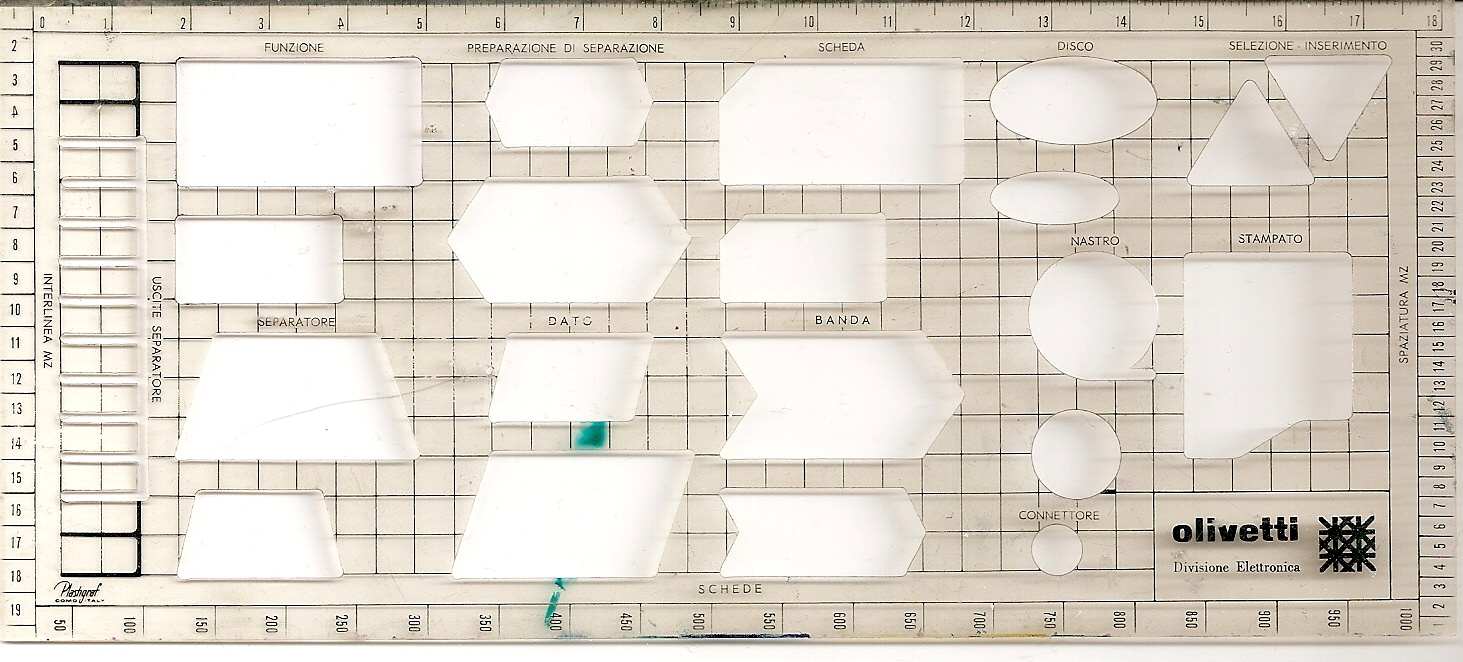
given a five to ten week course on machine language and flowcharting (see flowchart template). Our first
chance to work with a computer and run programs would come after the course, sometimes
much after. As we waited for a first chance to use the computer, we wrote on
paper and black ink, code that we thought was perfect …
Programming style
was most primitive. ‘Jump’ (or ‘go to’) instructions were used wholesale and
went in all directions. When a program had to be modified, programmers did not
dare to touch the code that had already started to work, they would rather make
a ‘patch’ in the form of a ‘jump’ instruction that would go to the end of the
program to the new code, and then jump back in. Later availability of an
assembler (called Psico) did not change the picture much, because the assembler
was slow and so programmers did not want
to reassemble a program every time a correction was needed (the source program
was stored on tape and each compilation took several tape passes).
Some people today
might wonder how anything useful could be done with computers having such small
memories. Well, some years ago I saw (Comm. ACM 48 (2), 99-101) a ‘Hello World’
program, written, according to the author, in ‘proper’ object-oriented
style. It had over 20 lines of Java-like
code. Its execution (let alone
compilation) would involve the execution of untold numbers of machine
instructions, including Operating System code. Granted, the same result could
be obtained by a much shorter program however apparently it would not be proper
OO style.
To show a trick,
let’s just print HELLO. On the Elea 9003, we could program this in 16
characters, two instructions; the rest of the memory would be empty.
05 0010 # ø Prints the memory contents from address
10 for length 5.
0HELLO # 0 Stops the program, also contains the
constant to print.
And how to execute
this program? Since it is short, we’ll type it directly in memory, 16
characters at address 1, so we type on the console keyboard:
16 0001 # %
Then we type the
16 characters on the console typewriter. Finally we branch to position 8, the
address of the rightmost character of the first instruction, entering the
following instruction from the console:
)# 0008 # O
This caused the
program to be executed. In modern terminology, this was our way to bootstrap on
the bare metal.
Did you understand
the trick? It is that characters 2-5 of the Stop instructions were not used, so
we could store there very short values. Simpler times…
Here is a
particularly daring trick: since instructions were of length 8, if a program
was loaded at address 1, then legal branching addresses were: 8, 16, 24, 32…
BUT a program could be organized in such a way that short executable sequences
could be encountered by jumping at intermediate addresses, such as 27. In such
a way one could have two partially overlapping programs. This trick was used in
the program Monitor, mentioned above. It was later understood that program optimization
can be much better achieved by using a transparent programming style. By the
way, we did not load programs at character O because we wanted to get the nicer
addresses mentioned above.
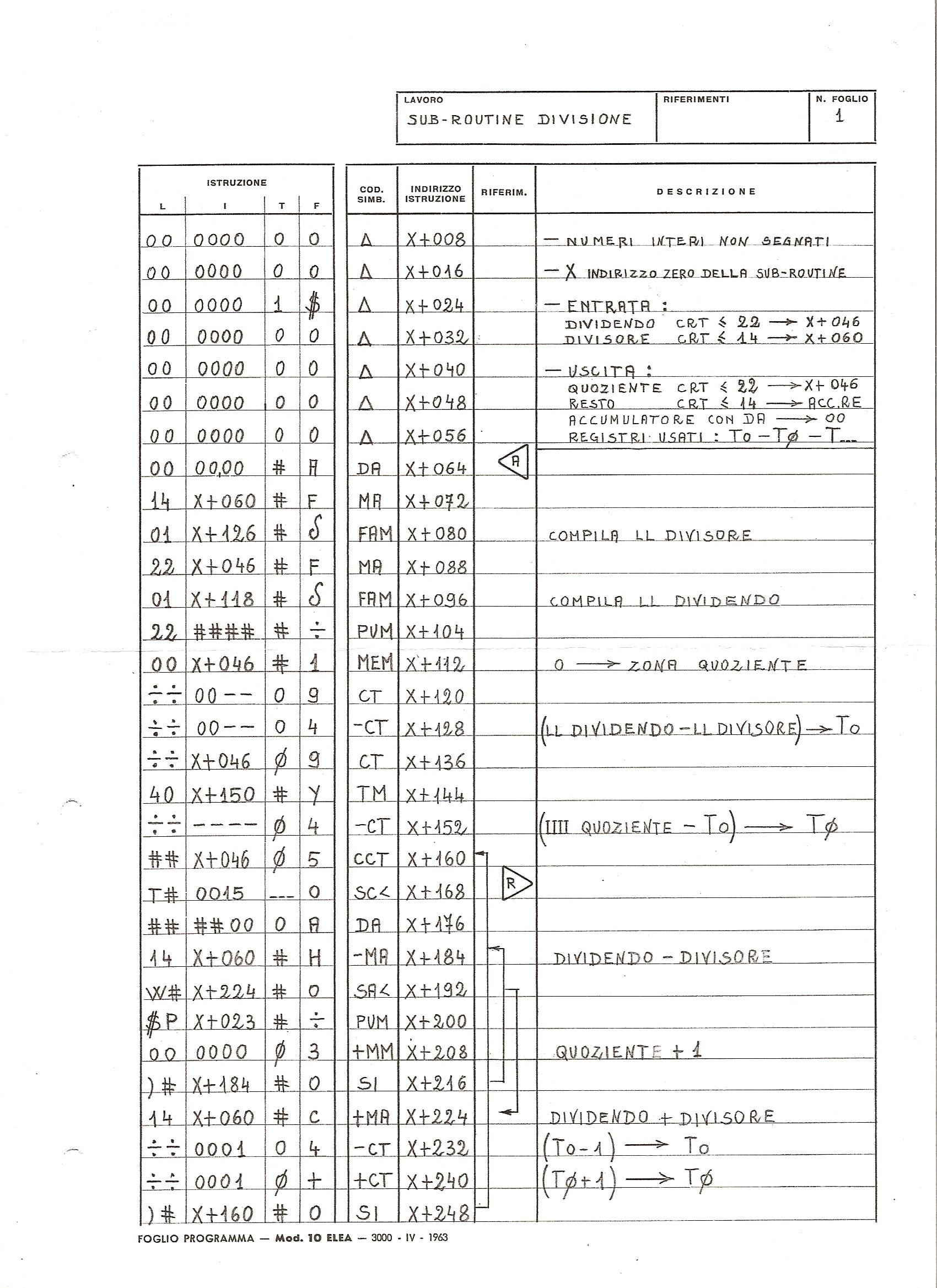
As example of
short mathematical program, I offer the attached long division subroutine (with
thanks to Prof. Stefano del Furia). In the absence of loaders and linkers, this
subroutine had to be copied in all programs that needed it. The addresses in
the subroutine had to be manually written in at the time the program was
copied. Address X was the address of
physical memory where the subroutine started in the program that used it. Note
that the subroutine is in the first column, the one titled ‘Istruzione’. The
rest are comments.
What application types did we work on? Payrolls,
inventory control, bank and insurance accounting were the bread-and-butter.
Information retrieval for industrial libraries was one of my specialties. Other
groups worked on Operations Research and Engineering applications. And,
thinking back, it is amazing how many possibilities were being explored, which
are still considered research topics now.
In the first years, the Olivetti Elea 9003 was plagued
by maintenance problems. Computers were maintained every morning by a team of
technicians. However by early afternoon things started to fall apart,
especially in the peripherals. Was there a non-recoverable read error in a
tape? Here is the fix. Perhaps the operator could still manually read in memory
the block, find the affected characters and replace them with a ‘reasonable’
interpretation of what should have been there. The whole tape could then be
reconstructed with the new block in place.
Computers were
hard to find in the early times. A programmer of those times recollected that a
janitor thought she had an identical sister, one going home at dawn and the other
arriving to work at 8:30. A manager asked for explanations when she discovered
that ‘the machine’ had been unused between 00:00 and 8:00 on a Christmas day.
(Hint: these two were the same person and she became famous in Italian IT
industry).
Because of the
absence of debugging systems, program debugging could be done only by
programmers themselves when the machine was available, usually in chunks of few
hours. This was usually at night, because in the daytime computers were used
for production purposes, to execute working programs. The problems just
mentioned, unavailability of software and maintenance issues, caused many
frustrations.
For example, here
is how programs were initially loaded for the first many months. They would be
punched on paper tape, and then read by the paper tape reader. Unfortunately,
this one would usually tear the tape, over and over. However before the tape
was broken, a portion of the program had been read in memory… so programmers
read the paper tape in memory a bit at the time, by repeatedly patching it, and
then assembled the program in memory by operations entered from the console.
The assembled program would then be copied to magnetic tape (itself fraught
with errors). When card input became available, the Bull card readers were slow
and unreliable.
Engineers usually
take existing systems as models for the new products they design. They usually want
to improve on something that already exists. So the question comes up, what
were the predecessors of the Elea 9003? I have not been able to find a clear
answer to this question. The main designers of the computer did not leave any
writings. Previously to their work at Olivetti, some of them had worked with
the Ferranti Mark 1, and one can recognize some of the characteristics of this
machine in the design: single address, fixed length instructions, accumulator,
index registers. However the Mark 1 was word-based rather than character-based.
I hope that some
of my readers will be able to help. It may be possible to find similarities
with other computers existing in 1957, the date of the Elea 9001.
My account of the
6001 will be shorter, because I used it much less. Also several of the
observations already made for the 9003 hold for the 6001.
The Elea 6001 was
designed as a smaller brother of the 9003, and as a scientific computer (it
would have been very nice if it had been just a scaled down 9003… ).
Production started
in 1961. About 170 were sold.
The Elea 6001 was also fully transistorized, with
ferrite core memory. Memory sizes were from 10,000 to 100,000 4-bit characters,
small sizes being the most common. It had a floating point representation for
reals. It had a microprogramming memory (called matrice di sequenza logica, or logic sequencing matrix), which was
used to microprogram mathematical functions such as multiplication, division
and square root in floating point. More advanced functions had been planned,
but they never got to the production stage.
The Elea 6001
memory was organized in characters of 4 bits.
As for the 9003, the binary coding of the numerals was peculiar (see programmer’s reference card). Of
course, only sixteen characters could be represented in 4 bits, which means
that numerical digits were represented by one character, while letters had to
be represented as combinations of two characters. This may be acceptable for
scientific applications, where numeric and alphabetic fields are separate. It
led however to the situation that alphanumeric fields, containing variable
numbers of alphabetic and numeric characters, were of unknown length between a
minimum and a maximum (more on this below).
Each character had
an extra bit, the ‘wordmark bit’ that delimited the length of the variables in
memory (more on this below). The bit was 1 if the character was the least
significant character of a quantity, 0 otherwise. The bit was also used to mark
the end of an instructions.
There was, of
course, floating point logic.
Instructions were of varying (and variable) lengths. A
typical instruction could be as follows:
OO
T IIIII
Where OO was the op code, T was the name of a register
(registers were used in the same way as for the 9003), and IIIII were five
characters of address. The full list of instructions is given in the programmer’s reference card. A
typical instruction would operate from the address IIIII + T for decreasing
addresses until it encountered a character with the wordmark bit 1.
Several of the characteristics of the 6001 were
difficult to manage for the machine code programmer, although they could have
been used to advantage by optimizing compilers:
1.
There was a scheme to save addressing bits in
instructions. While a regular address was of 5 characters, the programmer could
supply less if the initial ones were the same as the ones of the previously
encountered instruction. So, for example, in an instruction to address 12345,
the address could be written simply 345 if the previous instruction executed
was at address 12678. While indeed this scheme could save memory space, the
attention needed by the machine language programmer was considerable. At a time
when jump instructions were used wholesale, one could not be sure what the
previous instructions were, and the addresses of the previous instructions
could change as the program was debugged and modified.
o
In most cases, the programmer did not know exactly how
many characters would be affected by an instruction (although an instruction to
determine the distance between an address and the nearest wordmark bit was
available). The length of a data item was determined by the previous move to
that address, and so on recursively. E.g. if X had 4 characters initially, then
as a result of X = X+X, its size could become 5, while as a result of X = X x X,
its size could become 8 characters. The wordmark bit of X would move
accordingly. When moving data from an address X, one could in fact move the
last few characters of the data stored at a nearby address Y, if the data moved
to Y had overflowed to cover part of the area of X. Such errors were difficult
to detect and would propagate, in different ways with the different data and
execution paths through a program.
o
Because of the variable length of data, it was
difficult to interpret memory dumps (for some years, the most commonly used
debugging method). There were many ‘dead’ characters in memory that resulted
every time a value was overwritten by a new, shorter value. Data overflows were
difficult to detect in memory dumps.
In addition,
variable-length instructions made it difficult to calculate addresses in the
program, another problem for the machine-language programmer.
It should be noted
that such memory-saving tricks were not unusual in the small computers of the
time (among others, they were present in some IBM computers).
There was more software than for the 9003, as was
necessary, given the more complex programming. The software R&D division
produced an assembler and a compiler for Palgo, a dialect of Algol. However the
scientific programming world at that time (and for a long time thereafter) was
dominated by FORTRAN. So a compiler for FORTRAN had to be produced quickly by
the marketing division (by a staff of only three) a fact that caused
embarrassing rifts in the company. It is interesting to note that the R&D
division was historically correct, since many modern programming languages have
been influenced by Algol through Pascal, Ada,
C, and Java, while FORTRAN has remained almost without descendants.
At some point Olivetti realized that it needed a
computer for medium-size companies and the decision was taken that the Elea
6001 would be marketed for business applications. A number of them were sold
for this purpose. Given the memory structure used by the computer, I can only
feel sympathy for the programmers that had to program these applications. In
business applications fields are often alphanumeric, e.g. an address field
punched in a card typically contains variable numbers of numeric and alphabetic
characters. So a card consisting of 80 alphanumeric characters could take
anywhere between 80 and 160 characters in memory (the extremes being the cases
where it contained only numbers or only letters). This quantity was not known
until after completion of the read instruction.
Now, how to find the different fields in the card? Field lengths and memory
addresses had to be determined in some way for each card read, at execution
time (looking for spaces, looking for certain characters?). Similar problems
had to be solved for lines to be printed: some fields were of varying length in
memory but of fixed length on paper. Things that are simple in most computers
were headaches in this one.
Surely these
problems could have been helped by a high-level business-oriented language,
however I doubt that one was ever made available. Would you like to write a
COBOL compiler for this computer?
The 6001 was Olivetti’s answer to the IBM 1620, a
transistorized scientific computer announced in October 1959. It did share some
of the characteristics of the 1620. Its business version was an answer to the
IBM 1401, good luck!
Olivetti Elea 9004, Elea
9104
The Elea 4001 was a 7-bit computer, on which the
Olivetti engineering team worked around 1963. I gather from the information I
have found that it was not marketed and evolved towards an 8-bit computer
called Elea 4-115. In 1964 Olivetti sold its computer division to General
Electric and this machine was adopted by GE, becoming the GE-115. It was also
sold by Bull under the name Gamma 115. This one was a successful computer:
apparently about 5,000 were sold worldwide.
I have had no experience with these machines, but I have the 4001’s programmer’s reference card,
which I am making available in case it interests anyone.
Italian industrial
computing pioneers
The people who
worked on the Olivetti Elea R&D labs are the pioneers of industrial computing
technology in Italy, for both hardware and software.
The head of the
hardware R&D lab in most of the years covered here was Giorgio Sacerdoti,
following the brief tenure of the founder of the lab, Mario Tchou. The two are
shown front and center in this photo.
The photo shows also Pier Giorgio Perotto, who later directed the team that
developed the Programma 101, a remarkable small computer. Not shown is Federico
Faggin, who went on to extraordinary work in the USA. (There are Wikipedia pages for all the people just mentioned).
The software
R&D lab was called “Servizio logico-matematico’, and operated under Tchou
and Sacerdoti. This was the group of about 35 people mentioned above. The
director of the lab, Mauro Pacelli, with some key collaborators, are in this photo. This unit’s life was
approximately from 1958 to 1965. It was closed when the computer division of
Olivetti was sold to General Electric.
These are recollections
from my working experience at Olivetti, Computer Marketing division, from 1961
to 1964. They are written mostly from
memory, with the help of various sources. Corrections are welcome.
Interventions could be included in the form of signed addenda after my text.
Much additional
information can be found in the Web.
“Olivetti Elea” in Wikipedia
De Marco, G.; Mainetto, G.; Pisani, S.; Savino,
P: The early computers of Italy. Annals
of the History of Computing, IEEE
21(4), Oct-Dec 1999, 28 – 36
Mori,
E.: The Italian computer. IEEE Spectrum, 2019.
Parolini, G.: Olivetti Elea 9003: Between Scientific
Research and Computer Business. IFIP, History of Computing and Education 3,
2008, 37-53.
Answer to quiz above: According to Wikipedia and other
Web sources, the word software first appeared
in print in a paper by statistician John W. Tukey in 1958 in the American
Mathematical Monthly. Tukey is also credited with the invention of the word bit. However of course there are also
differing stories on the web…