Question #1
Write down the output of the following program segment. Getting the first,
second and third output lines correct are worth 6, 7 and 7 marks respectively.
You may use the next page as well. Hint: to receive partial marks, in
case you get the output wrong, you probably want to indicate what the four
pointers are pointing to after each line.
    int a = 1, b = 2, c = 3,
       *p1, *p2,
       **pp1, **pp2;

    p1 = &c;
    p2 = &a;
    pp1 = &p2;
    pp2 = &p1;

    if (**pp2 == *p1 + a) {
       cout << "TRUE" << endl;
    } else {
       cout << "FALSE" << endl;
    }

    **pp1 = **pp2 - a;
    *pp1 = p2;
    *p1 = *p2 + a;

    cout << "FIRST: " << a << ' ' << b << ' ' << c << endl;

    *pp2 = &b;
    p1 = *pp1;
    **pp1 = **pp2 - *p1;


    cout << "SECOND: " << a << ' ' << b << ' ' << c << endl;
| Assgn. |
a |
b |
c |
p1 |
p2 |
pp1 |
pp2 |
*pp1 |
*pp2 |
| p1 = &c |
1 |
2 |
3 |
&c |
? |
? |
? |
? |
? |
| p2 = &a |
. |
. |
. |
. |
&a |
? |
? |
? |
? |
| pp1 = &p2 |
. |
. |
. |
. |
. |
&p2 |
? |
p2 |
? |
| pp2 = &p1 |
. |
. |
. |
. |
. |
. |
&p1 |
. |
p1 |
| **pp1 = **pp2 - a |
2 |
. |
. |
. |
. |
. |
. |
. |
. |
| *pp1 = p2 |
. |
. |
. |
. |
. |
. |
. |
. |
. |
| *p1 = *p2 + a |
. |
. |
4 |
. |
. |
. |
. |
. |
. |
| *pp2 = &b |
. |
. |
. |
&b |
. |
. |
. |
. |
. |
| p1 = *pp1 |
. |
. |
. |
&a |
. |
. |
. |
. |
. |
| **pp1 = **pp2 - *p1 |
0 |
. |
. |
. |
. |
. |
. |
. |
. |
HENCE, the output is:
    FALSE
    FIRST: 2 2 4
    SECOND: 0 2 4
Question #2
Dynamic Memory Allocation & Arrays
Write a function with prototype int** alloc(int n, int m), which
allocates a 2n * m matrix, which has the property that the value a[i][j]
== a[i+n][j], or in other words, the ith and (i+n)th
rows are identical. Moreover, this property is intrinsically imposed by the
structure. For example, for n=2 and m=3, a 4 * 3 structure
is created
int **a = alloc(2,3);
a[0][0] =  1; a[2][1] =  2; a[2][2] =  3;
a[1][0] = -1; a[3][1] = -2; a[1][2] = -3;
// a[0][0] ==  1  a[0][1] ==  2  a[0][2] ==  3
// a[1][0] == -1  a[1][1] == -2  a[1][2] == -3
// a[2][0] ==  1  a[2][1] ==  2  a[2][2] ==  3
// a[3][0] == -1  a[3][1] == -2  a[3][2] == -3
You may assume that neither n nor m are 0. Hint: start
with part 3, you do not even need 10 lines.
   int** alloc(int n, int m) {
       int** a= new int*[2*n];
       for(int i=0; i< n; i++) {
          a[i] = new int[m];
          a[i+n] = a[i];
       }
       return a;
   }
Write a function with prototype void dealloc(int** a, int n),
which deallocates the 2n * m (m irrelevant}) structure passed in
a and allocated by alloc. You may assume that neither m
nor n are 0. Hint: start with part 3, you do not even need 10
lines.
   void dealloc(int** a, int n) {
      for(int i=0; i< n; i++) {
         delete [] a[i];
      }
      delete [] a;
   }
Draw a diagram which shows how such a 4 * 3 structure with n =
2 and m = 3 is arranged in memory. You may assume any pointer and
integer size and make up addresses, but do indicate what addresses are stored in
the pointers. 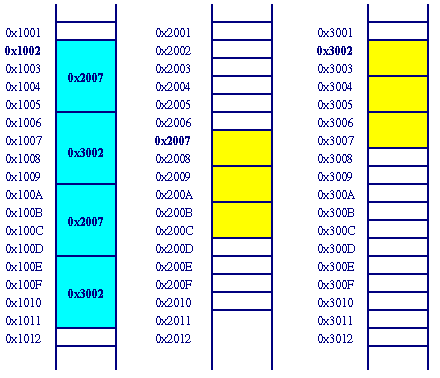
Question #3
Logical errors.
Would the following function swap the values of x and y?
Explain!
void swap(int *a, int *b) {
   int *c = a;
   a = b;
   b = c;
}


int x,y;

swap(&x,&y);
NO! The pointer variables a and b are
created on the stack when swap gets called. a holds &x
and b holds &y. After the body of swap is
executed, a holds &y and b holds &x.
However, a and b are destroyed when the function is finished,
the values in x and y have not been touched.
Find one error in the following program segment, and describe what
it is. Hint: there are no syntax errors!
int* f() {
  int *a = new int;
  *a = 5;

  return a;

  // a has the address of a dynamically allocated
  // piece of memory, OK

}

int& foo1(int* (*func)()) {
  return *(func());

  // as far as, func returns the
  // address of a global variable
  // or one on the heap, OK

}

int& foo2() {
  int x = foo1(f);

  // x is a local variable


  return x;

  // retrurning a local variable by
  // reference is a serious mistake
  // pp 42 in your notes

}

...
cout << foo2() << endl; // dereferencing the local x!!
...
Question #4
Consider the following class definition, method and function implementations :
class C {
  public:
    C();
    C(int);
    C(const C&);
    C& operator=(const C&);
    ~C();
};

C foo(C c) {
  return c;
}

C::C() { cout << "C::C()" << endl; }

C::C(int) { cout << "C::C(int)" << endl; }

C::C(const C&) { cout << "C::C(const C&)" << endl; }

C& C::operator=(const C&) { cout << "C::operator=" << endl; return *this; }

C::~C() { cout << "C::~C()" << endl; }
Answer the question posed on the following page.
Give the output of the following short code segment, and explain briefly but
clearly what caused each line to be printed! Hint: the two lines
are in a local scope!
...
 {
  C c1(5),c2;

  c1 = foo(c2);
 }
...
   C::C(int)         - for c1
   C::C()            - for c2
   C::C(const C&)    - creating the copy of c2 on the stack
                       (passed by value)
   C::C(const C&)    - returning the copy of foo's local c
                       (returned by value)
   C::~C()           - foo ends, c destroyed
   C::operator=      - for the assignment
   C::~C()           - the C object returned by foo
   C::~C()           - for c2, scope ends
   C::~C()           - for c1, scope ends
Question #5
Write a program with one function. The function takes an integer array
and its length and it returns an integer. The value returned is the smallest
positive value in the array, or 0 if all values are negative or if the length of
the array is 0. Call this function in main with an array that you
declared and initialized to perform this task.
  #include < iostream.h >

  int small_pos(int *a, int l) {
     int smp = 0;
     for(int i=0; i < l; i++) {
        if (a[i] > 0) {
           if (smp == 0 || a[i] < smp) smp = a[i];
        }
     }
     return smp;
  }


  int main() {
    int a[4] = {2,-4,1,0};
    cout << a[0] << ' ' << a[1] << ' ' << a[2] << ' ' << a[3] << endl;
    cout << "smallest positive: " << small_pos(a,4) << endl;

    return 0;
  }