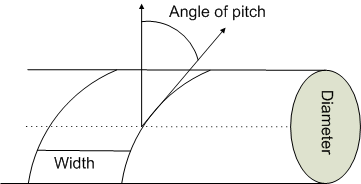
This example is given on page 6 of this book. The problem concerns itself with wrapping a section of tape around a pipe. It builds a model that produces a relationship between the diameter (C) of a pipe and the width (W) and angle (A) of pitch of a section of tape.
In real-life, we wouldn't know the answer, but in this case, the correct answer is W=C sin A. This relationship is the solution of the run and is what we want Absfract to output.
Once data has been acquired, we need to explain to Absfract how it should be understood. To do this, we start by creating new atomic types:
Insert Primitives AtomicType ty_TapeWidth
Insert Primitives AtomicType ty_TapePitchAngle
Insert Primitives AtomicType ty_PipeCircumference
enter the data in the system.
To do this, we have to indicate how the data should be read.