|
Majid
Mohammadian, Ph.D., P.Eng. Professor Department of
Civil Engineering University of
Ottawa 161 Louis
Pasteur, CBY A114 ,Ottawa, Ontario, Canada, K1N 6N5 Tel: (613)
562-5800-ext 6492, Fax: (613) 562-5173 Email: majid.mohammadian@uOttawa.ca |
|

|
Research on Sediment Transport Modeling |
|
|
|
|||
Numerical
methods for coupled sediment & flow interactions
Student: Xin Liu
Supervisor: Majid Mohammadian
Co-supervisor: Julio
Angel Infante Sedano
Intense sediment transport
and rapid bed evolution are frequently observed in rapidly varying flows, and
bed erosion sometimes is of same magnitude as flow. Simultaneous simulation of
multiple physical processes requires a fully coupled system to obtain an
accurate hydraulic and morphodynamical prediction. My research in this field is
geared towards developing high-order well-balanced fully coupled
two-dimensional (2-D) mathematical models consisting of flow and sediment
transport equations based on finite-volume methods. The 2-D shallow water
system with friction terms is used as hydraulic model and modified to take the
effects of sediment exchange and bed level into account on the wave
propagation. A 2-D non-equilibrium sediment transport equation is used to
predict the sediment concentration variation. Since bed-load, sediment
entrainment and deposition all have significant effects on bed evolution, an
Exner-based equation is adopted together with the Grass bed-load formula and
sediment entrainment and deposition models to calculate the morphological
process. The resulting 5×5 hyperbolic system of balance laws leads to a
challenging problem which requires specifically designed numerical methods
which are both efficient and accurate and can be implemented over unstructured
girds.
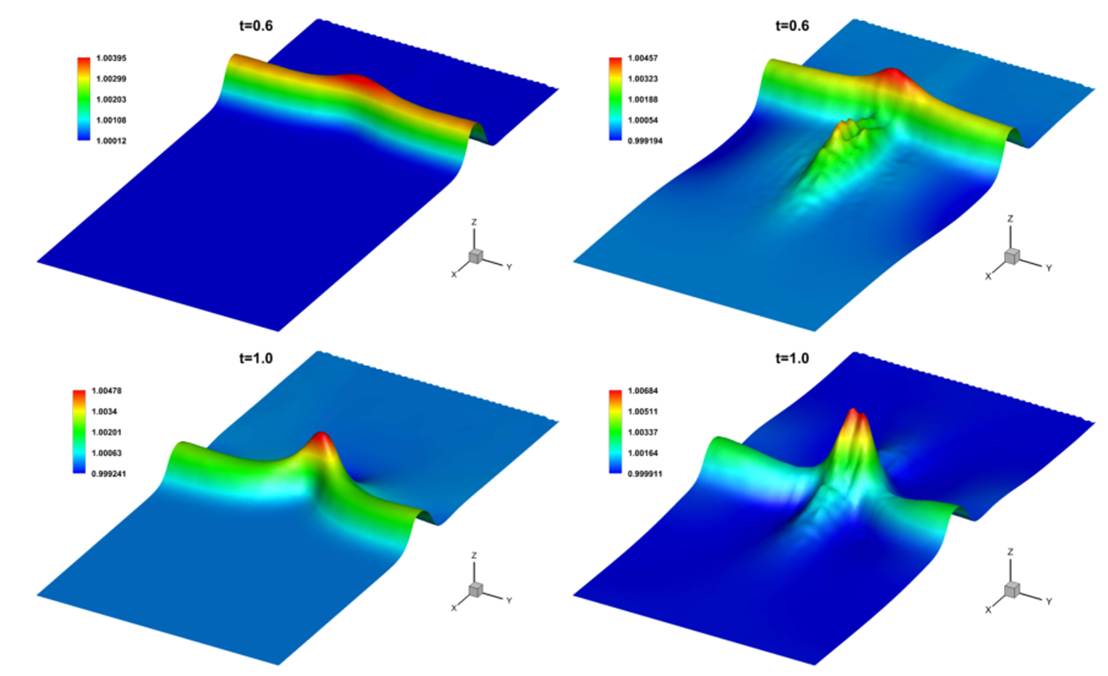
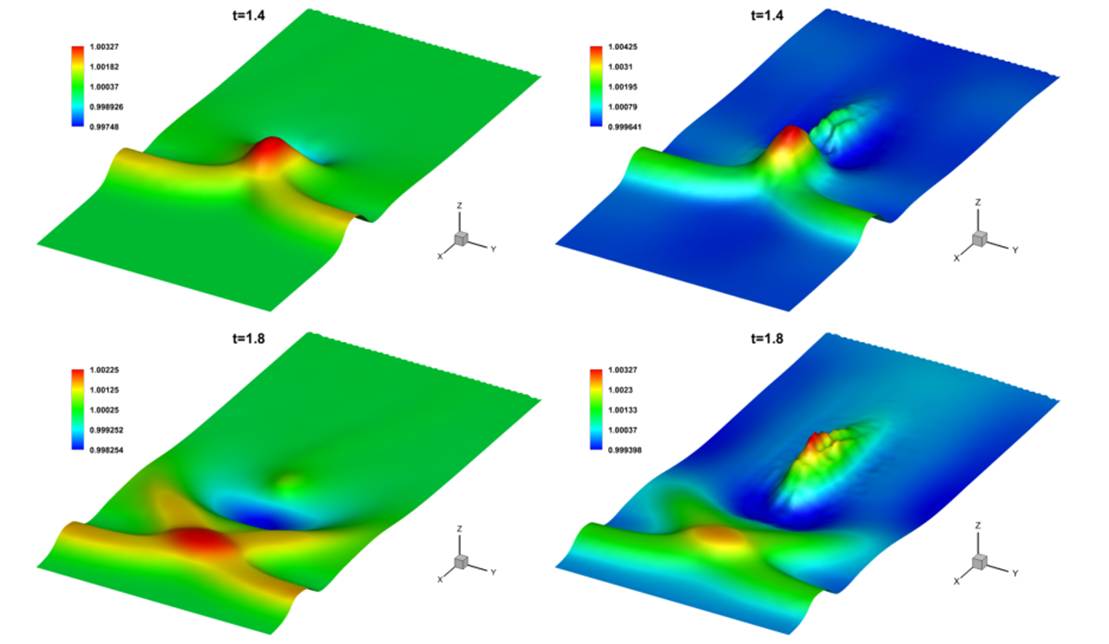
The propagation of small perturbation waves using well-balanced scheme (left column) and non-well-balanced scheme (right column) at different times
|
|
|
|
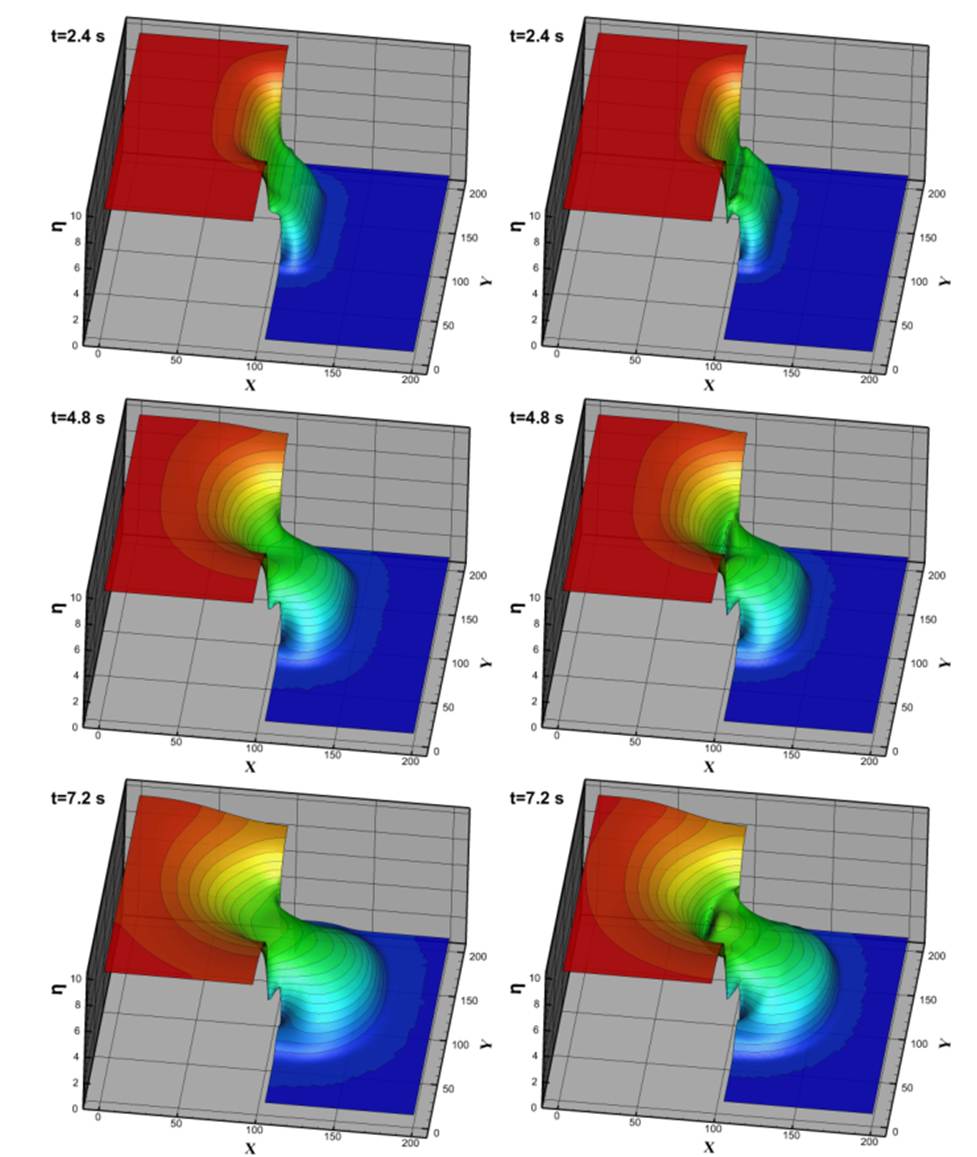
The water surface changes of current fully coupled mode (left column) and coupled model without bed evolution equation (right column) for test case of partially dam break flow over erodible bed at 2.4 s, 4.8 s and 7.2 s, respectively |
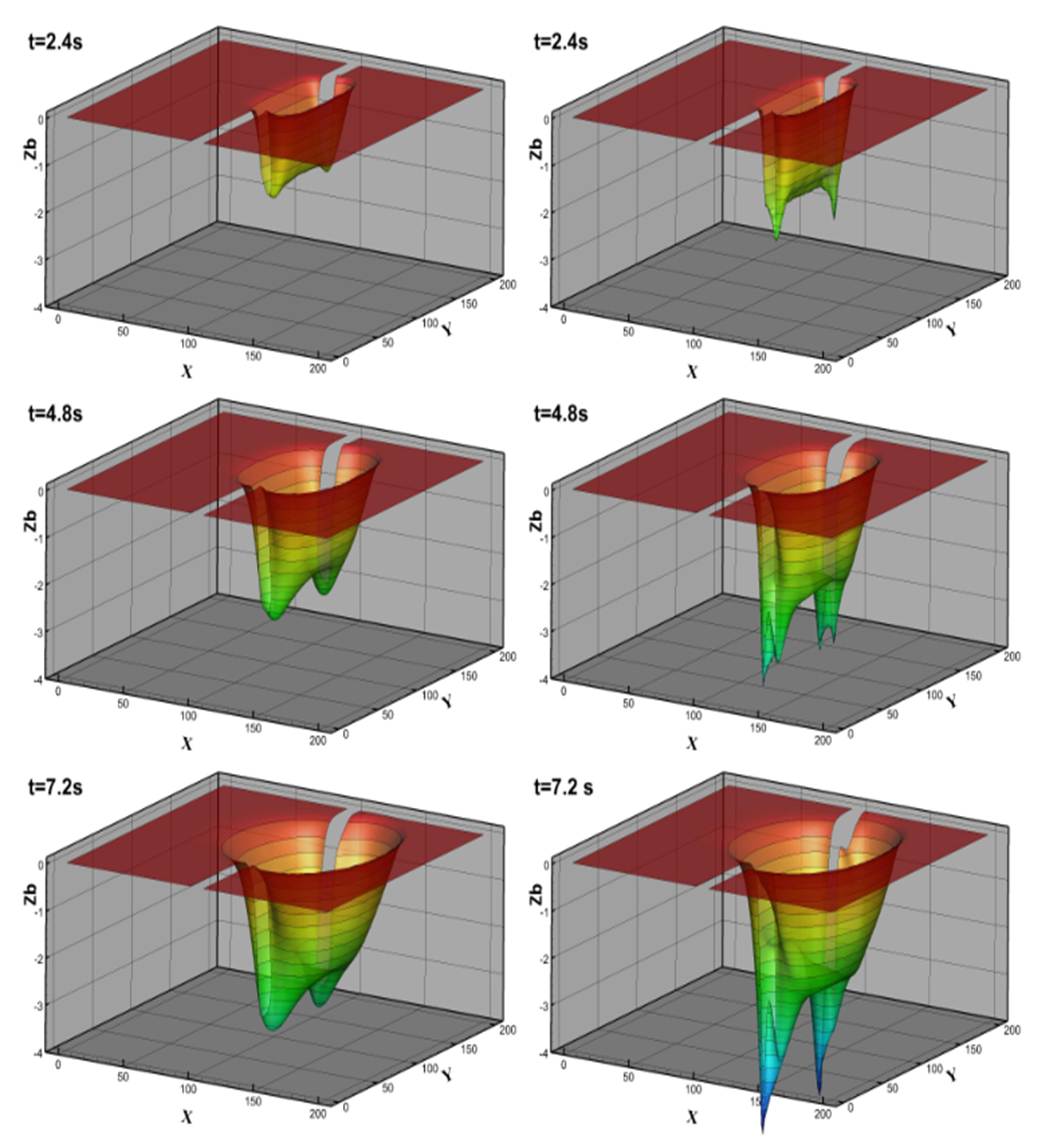
The bed evolutions of current fully coupled model (left column) and coupled model without bed evolution equation (right column) for test case of partially dam break flow over erodible bed at 2.4 s, 4.8 s and 7.2 s, respectively |