|
Majid
Mohammadian, Ph.D., P.Eng. Professor Department of
Civil Engineering University of
Ottawa 161 Louis
Pasteur, CBY A114 ,Ottawa, Ontario, Canada, K1N 6N5 Tel: (613)
562-5800-ext 6492, Fax: (613) 562-5173 Email: majid.mohammadian@uOttawa.ca |
|

|
Research on Computational Fluid Dynamics (CFD) |
|
|
||
|
|||||
|
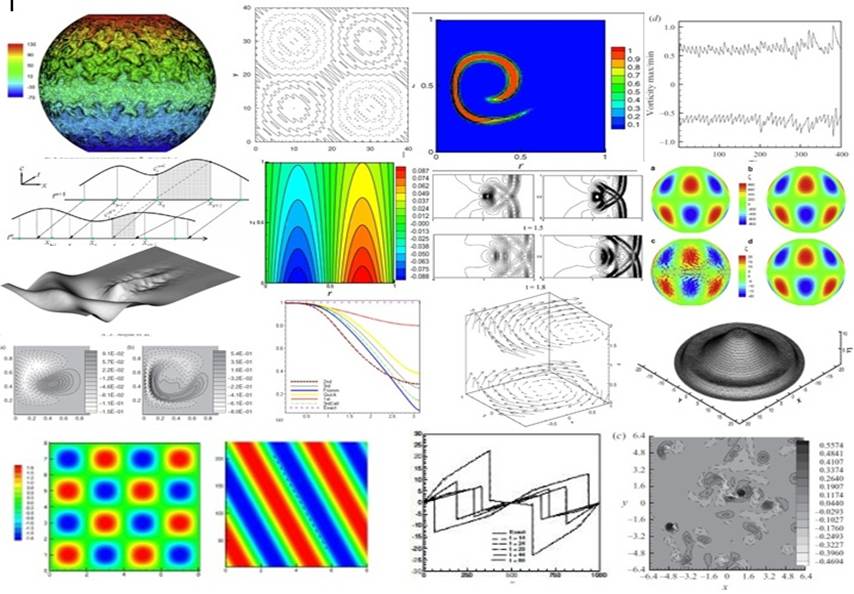
My research on numerical methods is geared towards developing
efficient and accurate methods for engineering problems related to Civil
Engineering. My research interests in this field include: |
|||||
|
1- Numerical methods for
shallow water flows with moving boundaries 2- Numerical methods for
large scale oceanic and atmospheric flows 3- Numerical methods for
coupled sediment –flow interactions 4- Numerical methods for
atmospheric boundary layer |
|||||
Numerical
methods for shallow water flows with moving boundaries
Shallow water flows
with moving boundaries exist in many natural situations concerning rivers,
lakes, estuaries and oceans. Dam-break flows, flood propagation, tidal currents
and river flows are examples for which shallow water equations have proven accurate
and reliable. Topographical (source) terms in shallow water equations are of
significant importance since they exist in almost all engineering problems.
Unstructured grids are of great interest in solving real natural problems
because of their capability of modelling complex boundaries and local mesh
refinement. Therefore, an unstructured finite-volume method with a capability
of modelling shallow waters with moving beds and boundaries has substantial
applications in management and improvement of water resources.
Finite-volume (FV)
methods are widely used in fluid dynamics because they can easily solve complex
flow regimes, including supercritical and transcritical currents. Moreover,
they conserve both mass and momentum, which is crucial for the correct calculation
of complex flows such as shock waves. However, they face some numerical
problems in modelling of source terms. This is because of imbalance issue
between the source and flux terms which could be very serious in real
applications. In the past decade, extensive research has been performed on
balancing source and flux terms. However, most existing schemes are
computationally expensive, restricted to structured grids or else they
introduce a high level of numerical diffusion.

Numerical
methods for large scale oceanic and atmospheric flows
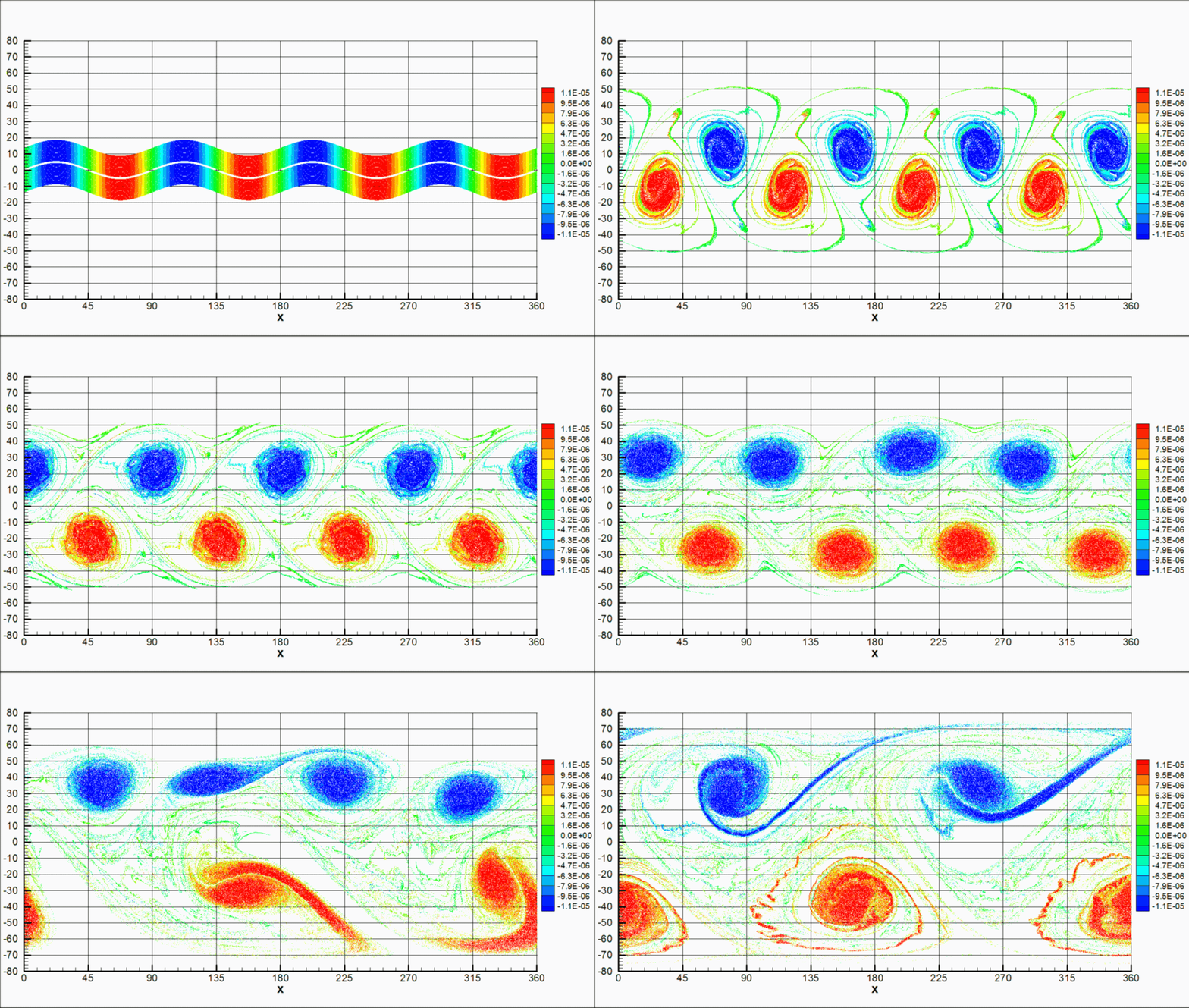
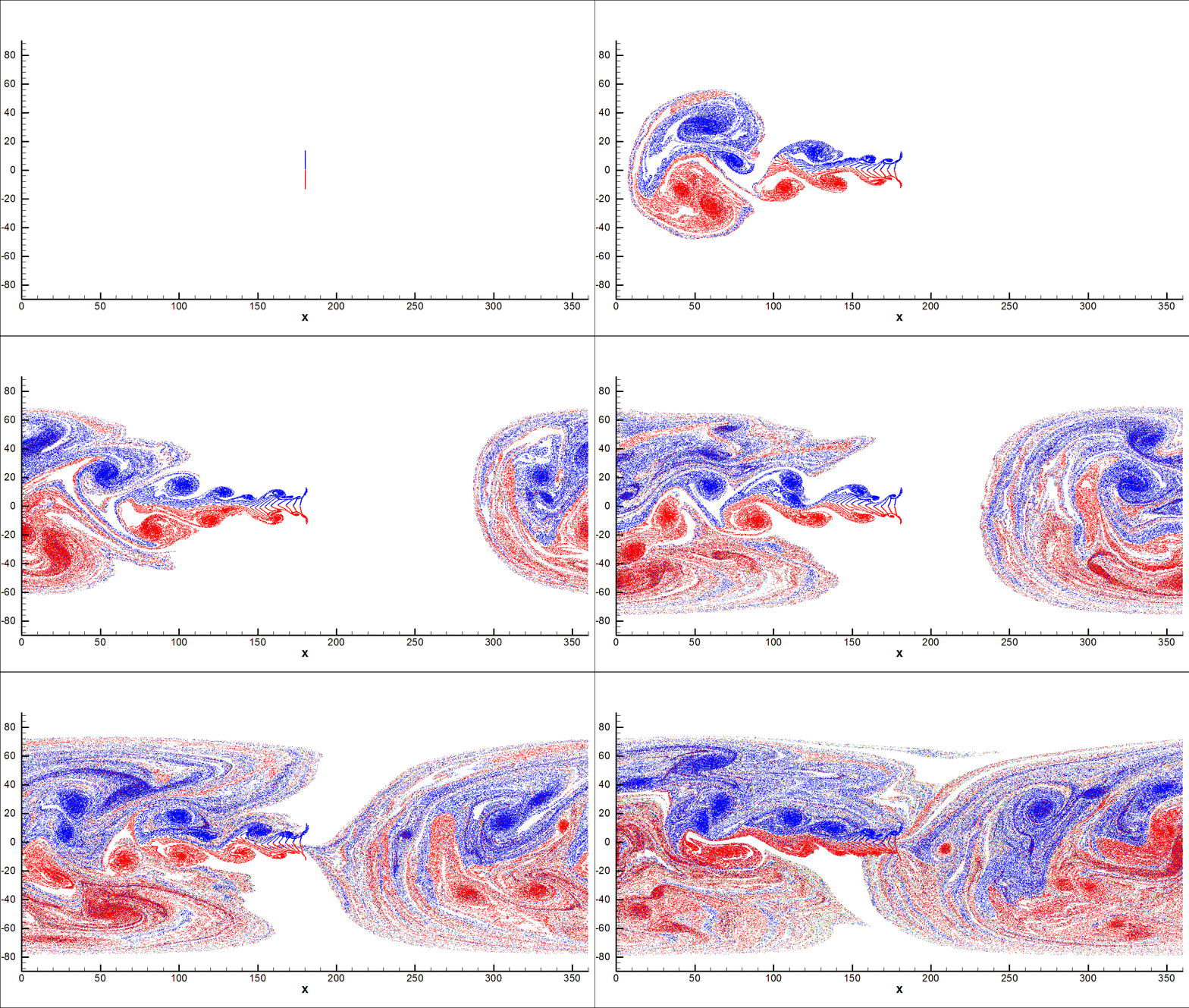
In oceanic and
atmospheric circulations, in addition to the convective terms, the Coriolis
effect also plays an essential role in the flow pattern. Indeed, the shallow
water system allows for several waves, such as gravity, inertio-gravity, and
Rossby waves, which have completely different structures. For example, the
phase speeds of these waves are largely different; gravity waves propagate with
a relatively fast speed, while Rossby waves are very slow.
Accurate simulation of
all waves is a delicate problem for most available schemes. In general, upwind
schemes perform very well for gravity and shock waves, but they are too
diffusive for Rossby waves. On the other hand, centered schemes perform better
for slow modes such as Rossby waves, but they present poor performance for
gravity and shock waves. The application of upwind schemes for
rotation-dominated cases still needs to be studied. For example, the phase
speed of Rossby waves and their damping due to numerical schemes is an
important issue in oceanic and atmospheric circulation modeling. Indeed, most
energy transfer in the ocean and atmosphere is performed by Rossby waves.
Therefore, damping of Rossby waves beyond a certain level is undesirable and leads
to erroneous results. On the other hand, in oceanic and atmospheric
circulations, small-scale and fast gravity waves are mainly considered as
noises which do not play an essential role in energy transfer and general
circulation. Therefore, in order to increase stability, it is usually desirable
to damp noises, which is perfectly done by upwind schemes. Thus, a desirable
scheme for the purpose of simulation of general circulation should present a
low level of damping of the Rossby waves, while damping noises.
|
|
|

Numerical
methods for coupled sediment & flow interactions
Intense sediment
transport and rapid bed evolution are frequently observed in rapidly varying
flows, and bed erosion sometimes is of same magnitude as flow. Simultaneous
simulation of multiple physical processes requires a fully coupled system to
obtain an accurate hydraulic and morphodynamical prediction. My research in
this field is geared towards developing high-order well-balanced fully coupled
two-dimensional (2-D) mathematical models consisting of flow and sediment
transport equations based on finite-volume methods. The 2-D shallow water
system with friction terms is used as hydraulic model and modified to take the
effects of sediment exchange and bed level into account on the wave
propagation. A 2-D non-equilibrium sediment transport equation is used to
predict the sediment concentration variation. Since bed-load, sediment
entrainment and deposition all have significant effects on bed evolution, an
Exner-based equation is adopted together with the Grass bed-load formula and
sediment entrainment and deposition models to calculate the morphological
process. The resulting 5×5 hyperbolic system of balance laws leads to a
challenging problem which requires specifically designed numerical methods
which are both efficient and accurate and can be implemented over unstructured
girds.

Numerical methods for
atmospheric boundary layer
Stability concerns are always a factor in the numerical solution
of nonlinear diffusion equations, which are a class of equations widely
applicable in different fields of science and engineering, including
atmospheric boundary layer. My research in this field is geared toward
developing efficient and accurate methods for the solution of nonlinear
diffusion equations, with a special focus on the atmospheric boundary layer
diffusion process. “Optimal schemes” are sought using various techniques such
as the development of low-diffusive and low-dispersive numerical methods which
remain stable for large time steps.
Development of numerical filters is also an approach that we follow. We
have developed Optimal Diagonally implicit Runge Kutta (DIRK) methods and Total
Variation Diminishing (TVD) schemes which have proved to be useful for
atmospheric boundary layers and the results have been published in various
journals including JCP. This research is supported by Environment Canada for
the Canadian whether prediction model.
Numerical methods for
Advection-Diffusion equations
Advection-Diffusion equations arise in various problems including
pollutant transport in water resources and atmospheric flows. My research in
this field aims at developing optimally stable, accurate, and low diffusive/
low dispersive schemes using various techniques such as Implicit-Explicit
Runge-Kutta methods (IMEX).

A lot of systems of
equations in Civil Engineering are of the type hyperbolic, such as shallow
water equations, Euler system, sediment transport equations, advection
equations, etc. My research in this field aims at developing accurate methods
with certain properties such as well-balanced property in complex planar or
spherical geometries using structured or unstructured grids.